

deep front line
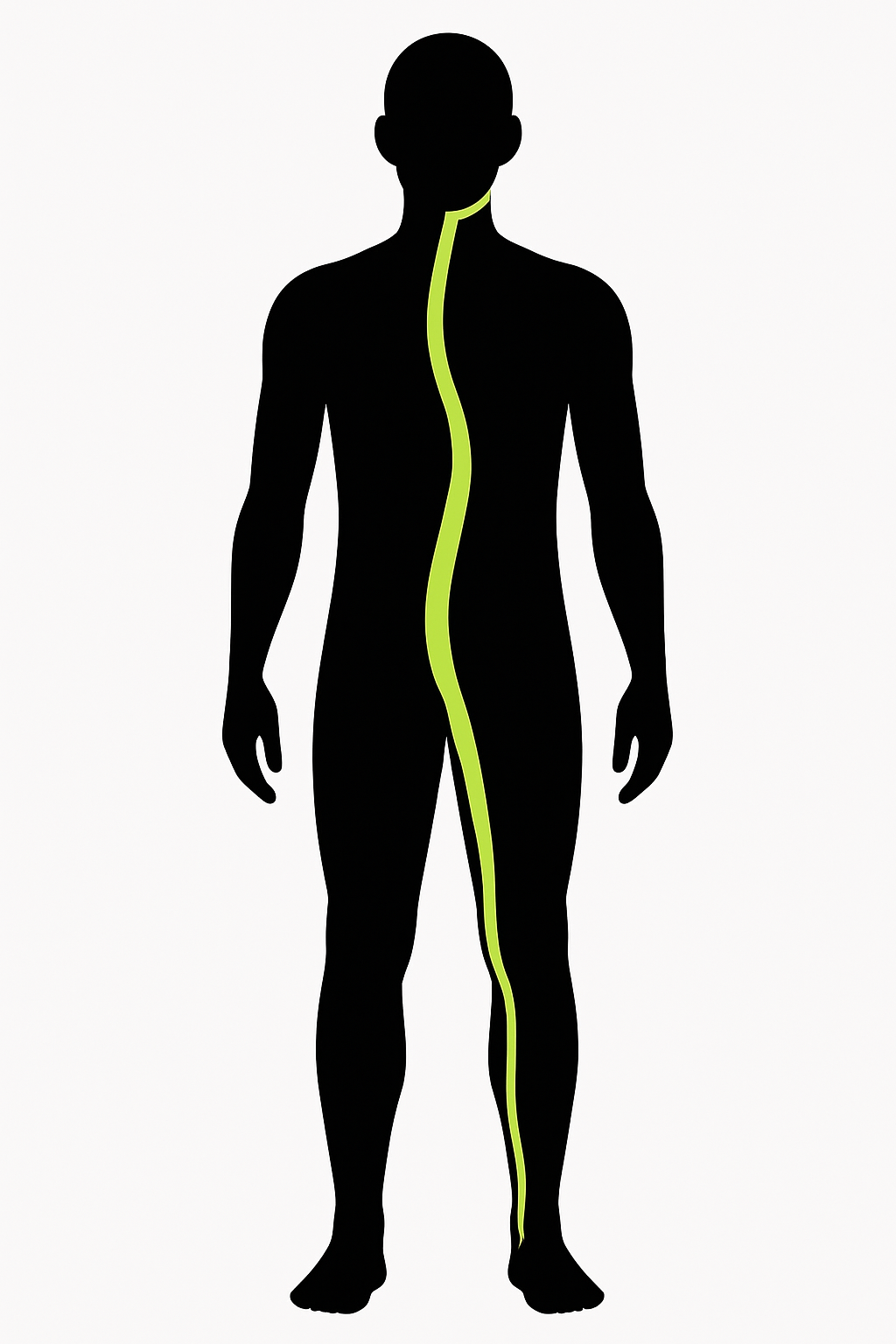
The inner core. Breath. Stability from the inside out.
The Deep Front Line (DFL) is the body’s deepest fascial plane, linking the inner arch of the foot, deep adductors, pelvic floor, diaphragm, psoas, deep spinal stabilizers, scalenes, and tongue. It’s not about movement at the surface—it’s the system behind postural control, diaphragmatic breathing, and organ support. It’s how you stand, breathe, and move with grace.
When It’s Tight or Dysfunctional, You Might Notice:
Chronic low back pain or instability
Shallow chest breathing
Hip impingement or poor mobility
Trouble staying upright without “locking out”
Neck tightness or jaw tension
Support & Mobilize It: How to Work the DFL
1. Diaphragmatic Breathing (3D Rib Expansion)
Why: Restores breath depth and core decompression.
How: Lie on your back, knees bent. Inhale through the nose into your ribs and pelvis, exhale long and slow. Feel the breath expand 360 degrees.
Time/Reps: 2–3 minutes.
Pro Tip: Focus on soft, quiet breath—let your ribs move.
2. Supine 90/90 Psoas Release with Heel Drag
Why: Targets deep hip flexor tension without over-stretching.
How: Lie on your back with feet on a wall and knees bent at 90°. Slowly drag one heel down the wall while maintaining pelvic tilt.
Time/Reps: 5–6 reps each leg.
Pro Tip: Don’t let the rib cage flare—keep it grounded.
3. Dead Bug with Balloon Exhale
Why: Activates inner core through breath + movement.
How: On your back, knees up, arms up. Inhale to prepare, exhale slowly through a balloon as you lower opposite arm and leg.
Time/Reps: 3–4 breaths per side, 2 sets.
Pro Tip: Use the balloon to regulate pressure and control.
4. Half-Kneeling Pelvic Floor Engagement (Kegel + Breath)
Why: Connects diaphragm, pelvic floor, and deep abdominal sling.
How: In half-kneeling, inhale deeply. On the exhale, gently lift through the pelvic floor as if drawing the sit bones together.
Time/Reps: 5–6 slow breaths.
Pro Tip: Keep glutes relaxed and breath soft.
5. Wall Spine Roll + Chin Tuck
Why: Mobilizes the spine from the deepest stabilizers.
How: Stand against a wall. Tuck chin, round upper spine one vertebra at a time as you slide down. Reverse to stand back up.
Time/Reps: 3–5 slow reps.
Pro Tip: Move with breath—one segment at a time.
Wrap-Up & Call to Action
The Deep Front Line is where strength meets stillness. It holds you up without tension, and lets you move without force. If you’re feeling stiff but unsupported, breathing shallow, or collapsing under fatigue—this is the line to work.
Let’s help you move from the inside out.
Book a session with D2H Wellness to align your deepest postural system.
Feel better. Move better. Live better.
— The D2H Wellness Team