

The Superficial Back Line
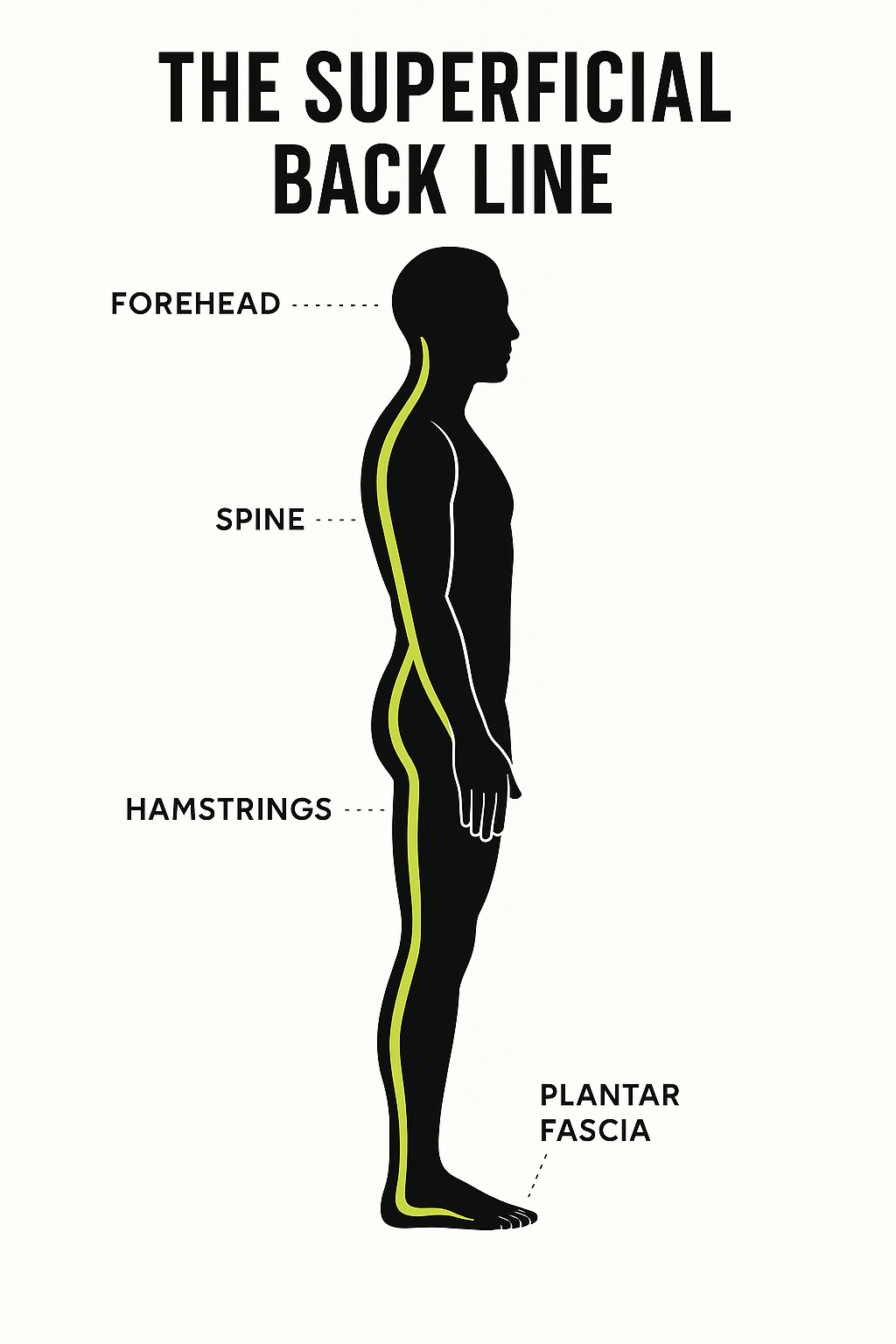
Where power, posture, and pain patterns intersect.
The Superficial Back Line (SBL) is a continuous band of fascia that runs from the bottom of your feet (plantar fascia)up through your calves, hamstrings, spine, and all the way to your eyebrows and scalp.
It connects the entire back side of your body—helping you stand upright, stabilize during movement, and absorb impact.It’s your body’s built-in “tension highway” for standing upright and staying connected head to toe.
When it’s restricted, you might feel chronic tension in your low back, hamstrings, calves, or even experience postural fatigue and headaches. When It’s Tight or Dysfunctional, You Might Notice:
Chronic hamstring or low back tightness
Poor posture and slouching
Headaches from scalp tension
Heel or plantar pain (think plantar fasciitis)
Tension you just can’t “stretch out”
Support & Mobilize It: How to Work the SBL
1. Standing Forward Fold (Ragdoll Style)
Why: Releases tension from the plantar fascia all the way to the scalp.
How: Stand with feet hip-width apart and knees softly bent. Hinge forward from the hips, letting your torso drape down. Grab opposite elbows and let your head hang heavy. Shift weight slightly forward into your toes and sway gently side to side.
Time/Reps: Hold for 30–60 seconds.
Pro Tip: Keep knees soft—this isn’t a hamstring contest.
2. Wall Calf Stretch (Straight & Bent Knee)
Why: Targets both superficial layers of your calf, essential links in the SBL.
How: Stand facing a wall and place your hands at chest height. Step one foot back. Keep the back leg straight, heel down. Lean into the front leg and press the back heel into the floor. Then bend the back knee slightly to target the deeper soleus.
Time/Reps: 30 seconds each version, per side.
Pro Tip: Actively press the heel down and lift your chest forward.
3. Seated Hamstring Floss (Nerve Glide)
Why: Mobilizes fascia and nerves—don’t skip it if your legs feel “stuck.”
How: Sit tall on the floor with one leg extended, the other bent in inner thigh. Flex the foot of the extended leg. Slump your back and point your toes on extended leg. Then lift your chest and straighten your spine (sit tall) as you pull the toes toward you. Gently keep your chin tilted; then repeat the movement.
Slump + point toes
Sit tall + pull toes back
Time/Reps: 8–10 smooth reps per side.
Pro Tip: This is movement, not stretch—go slow and smooth.
4. Glute Bridge with Slow Lowering
Why: Builds strength in the posterior chain—hamstrings, glutes, and spinal stabilizers.
How: Lie on your back, knees bent, feet hip-width and flat. Engage your glutes and lift hips until your body forms a straight line from shoulders to knees. Hold at the top for 2–3 seconds. Lower slowly over a 5-count.
Time/Reps: 10–12 reps - 3 rounds
Pro Tip: Drive through your heels, and don’t flare the ribs at the top.
5. Foam Roll: Plantar Fascia + Thoracolumbar Fascia
Why: Targets the bookends of the SBL—the feet and upper back.
How:
Feet: Stand with one foot on a ball. Slowly roll from heel to toes.
Spine: Lie with a foam roller under your upper back (below shoulder blades). Cross your arms over your chest and roll up and down slowly. You can use a lacrosse ball as well for more pin point work.
Time/Reps: 1–2 minutes each area
Pro Tip: Small, controlled movements. Breathe deeply.
Wrap-Up & Call to Action
If one link in the chain is stiff, the whole line compensates. That’s why releasing your feet can improve your neck—and vice versa. The body’s connected. Treat it that way.
Curious if your SBL is limiting your mobility or performance?
Book a session at D2H Wellness and let’s find your freedom of movement.
Feel better. Move better. Live better.
— The D2H Wellness Team